
Simpler Consent Forms, Higher Response Rates: What the Research Says About Readability in Schools
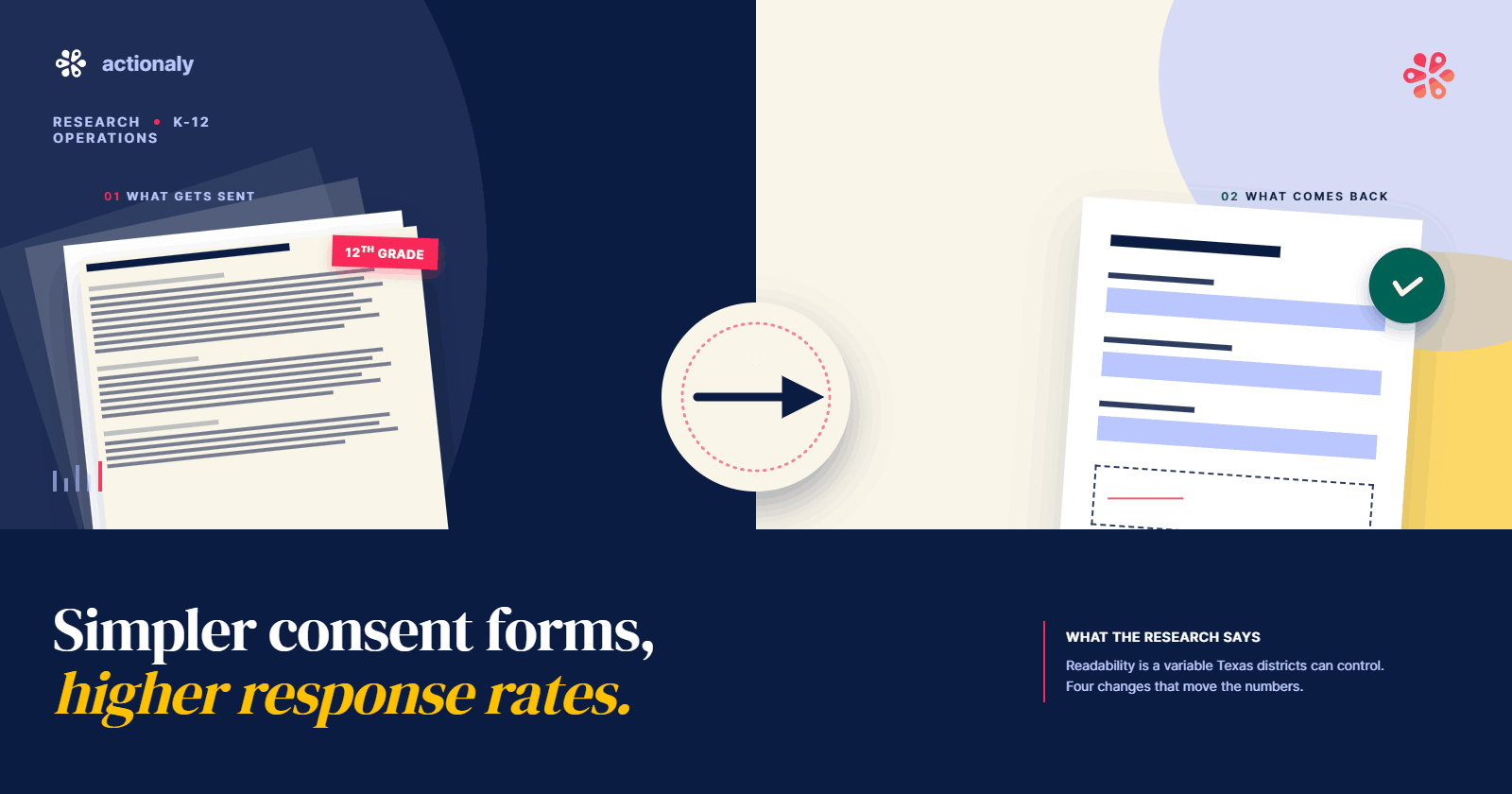
You've set up automated reminders. You're sending forms in multiple languages. You're following up on time. And you're still stuck somewhere around 65% response. Before you add another reminder touchpoint or another staff member to the follow-up list, there's a variable worth looking at that most districts haven't tested: the form itself. Across 798 federally funded studies, the average consent form was written at a 12th-grade reading level. The average American adult reads at 8th grade. That gap has a measurable cost.
Most Consent Forms Are Written Above the Reading Level of Most Parents
A 2024 meta-analysis published in The Lancet's eClinicalMedicine examined readability across 798 federally funded consent forms and found that each additional Flesch-Kincaid grade level increase was associated with a 16% higher dropout rate. The average form scored at a 12th-grade reading level, four full grades above the 8th-grade average adult reading ability.
That mismatch isn't evenly distributed. According to the 2023 federal PIAAC assessment published by NCES in 2024, 28% of U.S. adults scored at or below Level 1 literacy. In Texas, the rate is the same: 28%. That's 58.9 million adults nationally who read at the lowest measurable level. These are the parents receiving your consent forms.
For a mid-size Texas district, that 28% figure translates to roughly one in four families receiving a form they may not be able to read well enough to act on. The form doesn't look like a barrier. It looks like a normal document. But for a significant share of your families, the reading level alone is enough to delay or prevent a response. And under SB 12, a missing response means a student without access to services.
Jargon Triggers Disengagement Even When You Define It
The instinct when using technical language is to add a glossary or parenthetical definition. The research suggests that doesn't solve the problem. A study of 650 participants published in the Journal of Language and Social Psychology found that jargon-heavy text triggered disengagement even when definitions were provided alongside the terms. As the researchers put it, people who encounter language they don't understand tend to check out rather than look up the meaning. The barrier is psychological, not just informational.
This plays out in K-12 settings in a specific way. A 2021 Fordham Institute survey found that more than 80% of parents supported each of nine social-emotional learning skills when those skills were described in plain terms: teamwork, self-control, problem-solving. But the umbrella label "social-emotional learning" ranked as the second-least popular program name among the same parents. The content was identical. The language changed the response.
Consent forms carry the same dynamic. A form that asks parents to consent to "behavioral health screening services" is asking for permission to check in on how their child is doing emotionally. The first version signals institutional process. The second signals care. Both describe the same thing, but only one of them reads like it was written for the parent.
Shorter, Simpler Forms Produce Measurably Higher Completion Rates
The effect of simplification is not subtle. In school-based research, a four-page consent form yielded 64% parental agreement, while a shorter three-page form for a comparable study yielded 81%, a 17-percentage-point jump. (That study, published in the Journal of Empirical Research on Human Research Ethics, measured research-trial consent forms rather than district permission slips. But the mechanism is the same: length and complexity create friction, and friction produces non-response.)
At the scale of a school district, the numbers hold up. A Harvard Kennedy School experiment involving 131,312 parents found that rewriting truancy notification letters in simplified, non-punitive language reduced chronic absences by 40% compared to the standard legalistic versions. Same information. Shorter sentences. Simpler words. The result was a measurable change in parent behavior.
These aren't edge cases. They reflect a consistent pattern across studies: when you reduce the friction between the parent and the response, more parents respond. The form's reading level is friction. Its length is friction. Its tone is friction. Each one is a variable districts can control.
Plain Language Improves Comprehension for All Readers, Not Just Low-Literacy Ones
A common hesitation about simplifying forms is that it might feel patronizing to well-educated parents. A 2024 study published in Nature's Scientific Reports tested this directly. Researchers presented 192 adults with simplified and standard consent documents and found that plain language improved comprehension equally across all participants, regardless of reading skill, working memory, age, or educational background. The researchers described simplification as a "universal precaution," not an accommodation for struggling readers.
The operational benefits extend beyond response rates. When California's Administrative Office of the Courts rewrote its court forms in plain language, comprehension of one form's purpose jumped from 23% to 70%. The rewritten forms were 40% shorter and cut translation fees by 43%. Simpler English is faster and cheaper to translate accurately, which matters for any Texas district serving multilingual families. The readability of the source English form sets the ceiling for every translation that follows.
Four Changes That Make Consent Forms Easier to Complete
Based on the evidence above, four concrete steps districts can apply before the next consent cycle:
Run a readability check before sending. Free tools like Hemingway Editor score text by grade level in seconds. Target 6th to 8th grade. Most consent forms score 12th grade or higher without anyone realizing it. You can't fix what you haven't measured.
Cut the length. If your form includes paragraphs explaining why the district is collecting consent or summarizing the legislative history behind the requirement, remove them. Parents need to know what they're consenting to and how to respond. They don't need the policy background.
Replace jargon with plain descriptions. "Social-emotional learning program" becomes "a program that helps students practice skills like teamwork, self-control, and problem-solving." "Behavioral health screening" becomes "a short check-in about how your child is doing emotionally." The content stays the same. The language meets the reader.
Simplify before you translate. Every reading-level problem in your English form gets exported to every translated version. A simpler source document produces better, cheaper translations. This step pays dividends across every language your district serves.
The Form Itself Is a Variable You Can Control
Non-response is not a fixed cost of doing business under SB 12. A significant share of it traces back to how the form is written, not whether the parent cares. That's a problem with a known fix. Simpler language, shorter forms, and plain descriptions produce measurably higher completion rates across every study that has tested them.
We work with Texas districts on consent workflows, including how forms are designed and delivered. If you want to see how readability fits into your district's consent process, reach out any time.